
"Your Stream May Never Reach Your Favorite Artist" by Danica Calley
Picture this: Lydia rides the evening city bus, earbuds in, watching the blurred streetlights pass the window as an independent indie-folk artist hums in her ears. Discovered through a friend, the artist with only a few thousand monthly listeners plays constantly in her ears: while walking, while studying, while sleeping. Over 80% of her listening each month belongs to this one artist. Lydia enjoys knowing her monthly streaming subscription supports an artist she loves.
Except it doesn’t.
Not a cent of her subscription went directly to that musician. Rather, her money, along with the money of millions of other users, is poured into a pool of revenue and distributed mostly to artists she has never streamed at all. Lydia’s actual listening habits have no meaningful relationship to the artist she loves.
Lydia’s situation is not unusual. It is that of the modern streaming listener.
It is not unknown that the rise of streaming services has revolutionized the way consumers interact with music. Rather than purchasing CDs or downloading individual songs and albums, consumers now have access to millions of songs at the tips of their fingers. While more accessible than ever, this new model contains a revenue system that undermines artists’ economic value and the artist-listener connection that the industry once sustained.
In 2021, The New York Times reported that musicians’ demands for change have become “threaded with anger and anxiety over the degradation of creative labor,” noting that although industry revenues have grown, most artists receive “fractions of a penny” per stream. They not only struggle with low payouts, but they also experience an astounding lack of transparency surrounding their streaming wages. As one frustrated musician told Profesional de la Información, “…I don’t understand the breakdown of where my money is coming from.” This confusion is the anticipated result of a system designed around obscurity.
However, artists’ frustration doesn’t stem simply from per-stream rates or revenue nontransparency, but rather from the structural inequity of the industry’s revenue model itself.
How the Pro-Rata Model Fails Artists
Most major streaming platforms, including Spotify, Apple Music, and Amazon Music, use the pro-rata revenue model. Under this system, all subscriber revenue is pooled and distributed based on artists’ total number of streams. This means that a user’s subscription is not based on their listening, but by everyone’s listening. As a result, the majority of revenue falls into the hands of a small proportion of top-performing artists, typically those backed by major labels. The model leaves smaller, niche artists, who lack the same leverage, with only a fraction of what their listeners generate.
The effect becomes easier to understand when we imagine an extreme case where a streaming user only listens to a single artist in a given month. Under the pro-rata model, the percentage of the user’s distributable subscription revenue that artist receives depends on how many times that user streams the artist. This effectively disregards individual consumer behavior in favor of sheer streaming volume.
The inherent opaqueness of this model makes the exact figures difficult to track, but we can examine per stream rates to paint a better picture. When examining the average artist payout per stream, it can be observed that musicians experience a deflation of income.
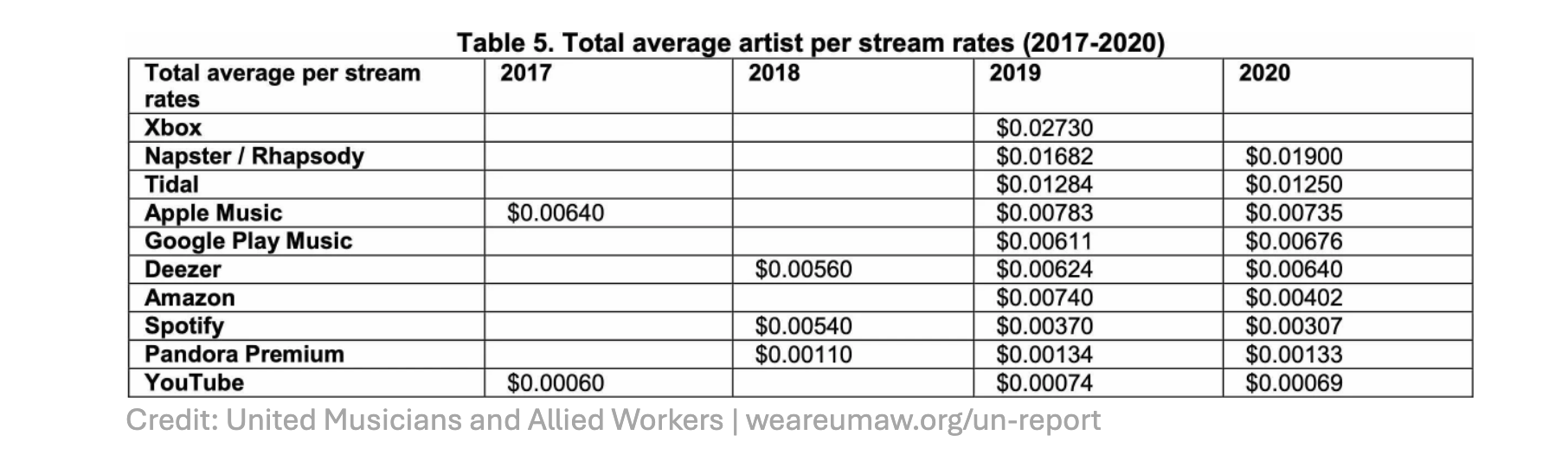
In 2020 when the music industry experienced an immense surge in revenue, per stream rates remained less than a cent, often less than half of one. Meanwhile, according to United Musicians and Allied Workers, major labels and their associated artists earned nearly a million dollars per hour from streaming and tens of thousands of artists earned five figures. Most creators still receive a fractional amount for their streams.
This is profoundly unfair. And historically, it was not always like this. Under the old, pre-streaming system, artists thrived with the support of loyal listeners. When fans bought physical albums, such as CDs, vinyls, or digital downloads, a meaningful proportion of those purchases went directly to the artist. Even modest sales from a smaller, loyal fanbase could potentially sustain independent artists. The old system was by no means perfect, but at the very least it ensured that a devoted fan base translates to a proportional income.
Streaming platforms give the illusion of personalization, creating individually tailored playlists, recommended tracks, and an annual “wrapped,” or personalized recap of a user’s listening history. Yet a user’s individual listening habits are erased once their money enters the distribution system. Lydia may spend 80% of her listening time on an independent indie-folk musician, but the pro-rata system funnels her money to the platform’s top-performing artists.
To the artist, streaming was meant to be an opportunity to reach global audiences and to receive an even playing field for all artists. To the listener, streaming was meant to be a convenient alternative to listening to and discovering music through personalization. The current system has failed on both accounts.
But the pro-rata model is not irreversible. There are different options the industry can consider.
The User-Centric Model and Why It Works
Upon the examination of numerous alternatives models and their probable consequences in the industry, studies have consistently found one model that stands out from the rest: the user-centric model.
Under the user centric model, a user’s subscription fee is divided only among the artists that the user streams. If Lydia’s indie-folk musician makes up 80% of her listening, her artist would receive 80% of her distributable subscription fee. Suddenly, the relationship between listeners and artists becomes more direct and more transparent.
And the effect is not small.
Multiple studies analyzing real platform data indicate that the implementation of a user-centric model would significantly shift revenue towards niche genres and small and developing artists, those who often have devoted fanbases but lack the leverage to compete with larger artists. This change would not diminish top-performing artists’ wages, either; they would earn solely the revenue generated by their fanbases.
The user-centric model only changes the fairness of the distribution.
Some critics argue that the current system reflects the general public’s preferences, suggesting that top-performing artists should receive higher proportions because they are more popular. But this overlooks the pro-rata model’s artificial inflation of their wages. The user-centric model ensures that an artist is paid proportionally to their listeners’ generated income, no matter how small or how large that artist is.
Others argue that platforms depend on larger artists to attract more users, and therefore they deserve higher payouts in return for their added value. However, why should other users who do not listen to these artists pay for this? This idea attributes popularity to value for all users, even those unaffected by this popularity. The user-centric model credits value as personal, not platform-wide.
Of course, because no major streaming platform has implemented the user-centric model to date, there are uncertainties to be acknowledged. While research has shown that the user-centric model supports a fairer distribution of revenue, until a platform actually makes the change, the findings remain theoretical. Nonetheless, the evidence is strong enough, the inequality is large enough, and the potential effects are significant enough that something must be done.
But Why Should You, a Music Listener, Care?
You may wonder why this matters to the average streaming user. Streaming has majorly simplified and cheapened music listening on the user-end, providing instant access to an enormous library of music. Given that platforms have made streaming so effortless, why should you worry about how the platform uses your money behind the scenes?
It’s simple—every stream is an act of consumption. When you listen to a song, you’re consuming the product of hours upon hours of creative and emotional work. Streaming has made this consumption feel effortless and insignificant, but it hasn’t made it free. Someone is being compensated for the music you listen to, but often, it is the wrong artist.
As consumers, we assume this correlation in almost every other part of our lives. If you buy a book, you expect the author (not a best-selling author of a book you’ve never read) to receive compensation for your purchase. If you buy a local painting, you would be frustrated to learn a world-renowned painter you’ve never heard of received your payment simply because they sell more canvases.
Even if we consider compensation in non-creative spaces, there is still an inherent expectation that our monetary contributions align with our intentions. If you purchase a cup of coffee from a local café, you don’t expect the payment to be pooled with Starbucks’ income. If we took the analogy one step closer to the pro-rata model, the situation becomes even more unequal. Imagine all money spent at independent cafes and local bakeries is poured into the same pot as the money spent at Starbucks. At the end of each month, the money is divided among all baristas based on total number of coffees sold.
What this model fails to account for is the inequity between companies and even between individual baristas. Starbucks is a multi-billion-dollar company that benefits from million-dollar marketing strategies, market dominance, brand recognition, and high customer traffic. Small coffee companies rely on steady local customer loyalty. Additionally, some baristas may be favored by management, given the best shifts, and receive the best position. In this pooled system, baristas would receive an income disproportional to their customers’ generated income.
Your six-dollar frappe from your favorite local café ends up supporting the barista at the busiest Starbucks in town, simply because that barista sells more drinks overall. Meanwhile, the barista who learned your name, remembers your order, and made your drink only receives a fraction of what your purchase generated. Your preferences and intentional consumer behavior are immediately lost in your transaction.
This mirrors the dynamics of the music industry under the pro-rata model. Top-performing artists and their major label backing work with massive marketing budgets, paid playlist placements, and large industry leverage, while independent and small artists rely on small loyal fanbases. Consequently, small artists experience a disconnect between their fans’ intentions and actual compensation.
When you choose to spend your time and attention on an artist’s music, there is an expectation that your consumption supports that creator. Streaming platforms have obscured this connection, detaching listeners from the real effects their choices have. If an artist’s career can only survive when they can afford to make music, then the effects of the revenue model become very real. And when careers are leveraged on your consumer behavior, there is a certain responsibility to ensure the effect corresponds to your listening intentions.
Caring is not an unreasonable burden. It acknowledges that your listening has real consequences. If music has improved your life, if an artist’s work has moved you, lifted your spirits, or followed you through dark times, then ensuring your streams support that artist is the most basic obligation. Just as you would prefer your local barista to be paid fairly for their work, you should expect the same condition for artists. A user-centric model doesn’t require more money or more effort. It simply ensures a user’s choices supports their artist.
The current pro-rata model has had its run. It has supported a growth in industry revenue and created unprecedented access to music. Yet, it has failed the very people that make up its foundation: the artists.
What began as a personalized listening experience, fit with endless new creators and seemingly infinite songs, became an obstacle in the artist-listener relationship. As long as the pro-rata model remains the industry standard, the connection between the artist and the fan is lost to a system that values numbers over individuals.
A user-centric model may restore this severed thread. It could allow Lydia’s late night bus rides, her study sessions, her passive listening to hold real, traceable impact on her favorite artist.
Behind every single stream is a listener. And behind every listener is someone like Lydia who believes her loyalty makes a difference. It’s time we make that system true.