
“Acknowledging Media Bias: The Unfair Portrayal of Police Officers” by Isabelle Maisano
4:00am, Childhood
A little girl, no older than five, wakes up around four in the morning. It is just an average weekday, nothing special. Her father has just gotten home from work, and her mother has to get up soon to get ready herself. The girl climbs out of bed with her stuffed jaguar plush, quietly sneaking down the hall to her parents’ bedroom. It is dark, and despite being scared of monsters in closets, she makes the journey. She climbs up into bed, waking her mother up as she gets under the blankets and lays on her father’s arm while he sleeps. There will be an hour or so of peace, the whole family together, before the mother will get up for work and take the daughter to daycare.
Now, Adulthood.
This little excerpt of my life is one of my most prominent memories of my childhood, a memory I remember from many instances before my father moved departments and did not have to work night shifts anymore—shortly before my sister was born in 2009. Now, as a first-year college student, I have lived long enough to begin to understand the kinds of views others have on my father’s profession. From my perspective, police officers have always been heroes. I’ve never seen them as anything else, not until I began to understand that sometimes bad things happen, and sometimes bad people are disguised as good. Even learning these things, though, I still believe that most Law Enforcement responders are good, and I have observed too often people making judgements without seeing the whole picture.
Which brings me to my father.
My father, who has been working for over twenty years in Law Enforcement, has had many different jobs within many different Maryland departments. He has been a traffic cop, a detective in multiple departments in the Baltimore-Towson area, and an intelligence analyzer as of late. In his years working as a police officer in Maryland, he has seen friends come and go in different departments—he has seen friends die on the job, and he has seen friends retire happily like any other normal person.
He sees the humanity behind our officers in black and blue. He has a firsthand account of the individuals working in the system, a firsthand account of the people who protect communities at the most personal level. He has a perspective that even I as a dependent of a police officer will never have. He has made personal relationships with the people behind the entity of the Law Enforcement system, the individual cogs of this powerhouse that people have come to criticize and demand the abolishment of in past years.
The average person cannot truly see Law Enforcement this way. At the most, a supporter of the police can get to know the department that protects them, but the average person neither has the time nor the cares to try and get to know their local police officer. Rather, it is more likely that the average American will get their information about Law Enforcement from social media. Social media platforms like ‘X’ (Twitter), Instagram, and Facebook allow people to communicate news and new information to each other in fractions of seconds. And anyone can do it—that is the beauty of having free speech in America. Our ability to go online and share our opinions creates an environment of healthy discourse and debate… Or does it?
The Recent Past, How Social Media and the News Affected Outlooks on Police and Law Enforcement in America
Working in Law Enforcement takes a mental toll over time. Academic research has been done to prove a correlation between police officer stress and both mental and physical health issues later in life. My own father has developed high blood pressure and other stress-related health issues due to the nature of his job. In addition to the job stress, in recent years, social media has had a negative effect on my father’s mental health.
As instances of police brutality were televised across America, increasing distaste and hatred for Law Enforcement came to the forefront of social media platforms, news channels, and personal blogs. The catalyst of these instances of police excessive force was the death of George Floyd on May 25, 2020. Up until that point, there were scattered instances of police brutality, with the most polarizing of them in my father’s life being the death of Freddie Gray in April of 2015.
But truly none were so publicized as George Floyd, whose death sparked outrage across America and prompted months of often violent protests (or riots, depending how the individual interpreted the state of the country at the time).
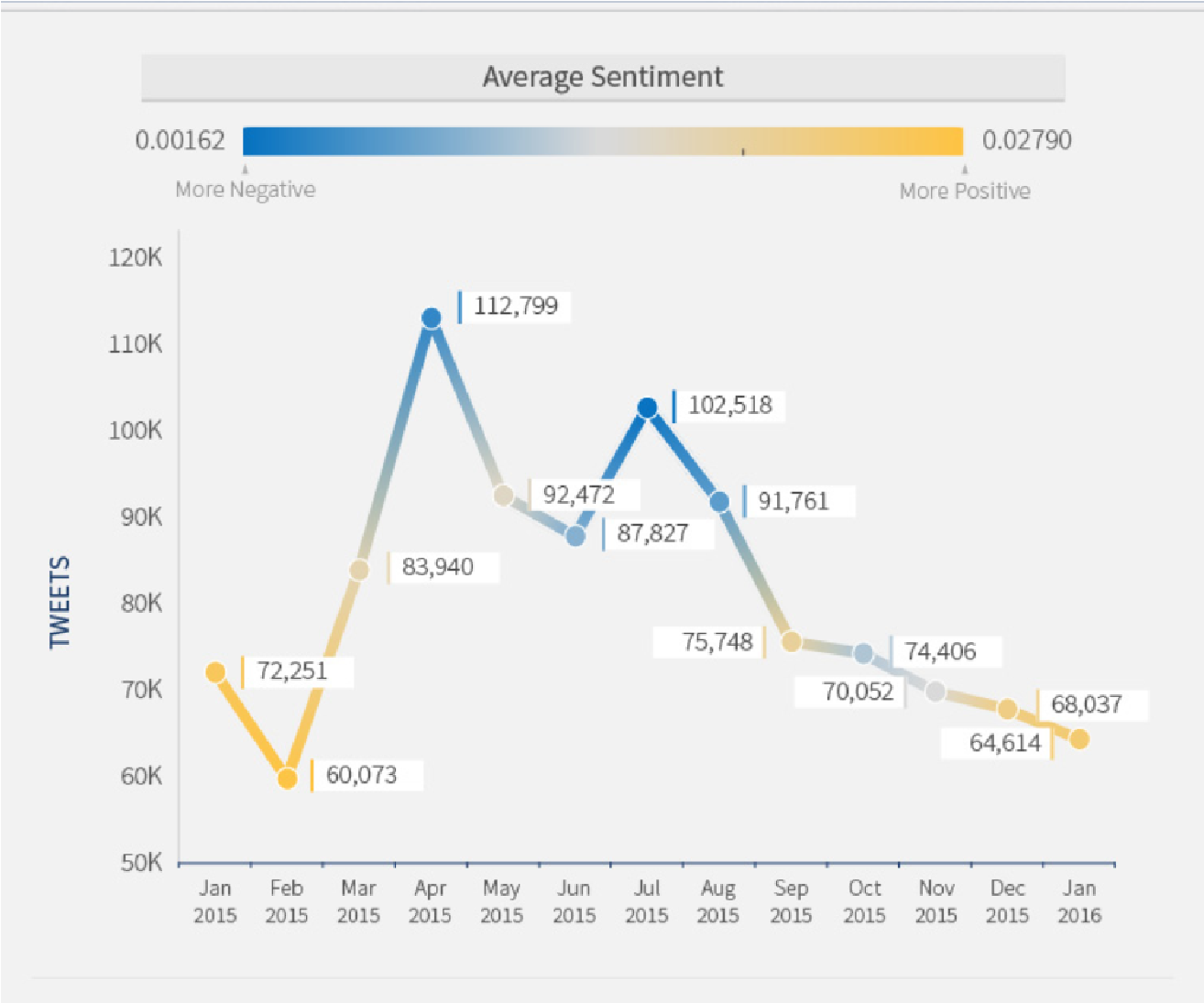
Social media was a huge contributor to the negative perceptions of police officers during this time. Media sources portrayed data without right comparisons, isolating instances of police brutality and misconduct from overall police interactions.
A study was conducted by Production1, where an analysis of Twitter posts from over many years determined trends of positive and negative Tweets about police. Data was taken from the year 2015 in the graph above, with the data leaning positive in nature. The negative fluctuations are correlated with mass media coverage of brutal police misconduct—as to be expected when something horrifying happens. These events should be covered. The issue lies in when these events are isolated from data that shows all police reports over time.
For example, in 2015—the same year of Freddie Gray’s death—these are the different arrests made. This data was taken from the Federal Bureau of Investigation (FBI) Crime Data Explorer (CDE). These numbers are exponentially larger than the number of police-related misconduct incidents for that year. A study from the University of Southern California found 20 recorded instances of police misconduct for various issues ranging from harassment to corruption (this is an incomplete list, but still helps to put the numbers in perspective).
| Crimes (2015) | Arrests Made (2015) | |
| All Other Offenses (Except Traffic) | 2,729,688 | |
| Drug Abuse Violations - Grand Total | 1,166,244 | |
| Larceny - Theft | 984,109 | |
| Simple Assault | 913,474 | |
| Driving Under the Influence | 898,058 | |
| Drunkenness | 345,435 | |
| Disorderly Conduct | 336,442 | |
| Aggravated Assault | 315,085 | |
| Liquor Laws | 228,802 | |
| Burglary | 182,360 | |
| Vandalism | 161,733 | |
| Weapons: Carrying Possessing Etc. | 121,292 | |
| Fraud | 113,014 | |
| Offenses Against the Family and Children | 83,114 | |
| Robbery | 79,659 | |
| Stolen Property: Buying Receiving Possessing | 74,439 | |
| Motor Vehicle Theft | 64,651 | |
| Forgery and Counterfeiting | 46,492 | |
| Sex Offenses (Except Rape and Prostitution and Commercialized Vice) | 43,949 | |
| Curfew and Loitering Law Violations | 36,353 | |
| Prostitution and Commercialized Vice | 33,847 | |
| Vagrancy | 21,781 | |
| Rape | 19,218 | |
| Embezzlement | 13,408 | |
| Murder and Nonnegligent Manslaughter | 9,614 | |
| Arson | 7,519 | |
| Gambling - Total | 3,852 | |
| Suspicion | 2,286 | |
| Manslaughter by Negligence | 923 | |
| Human Trafficking - Commercial Sex Acts | 0 | |
| Human Trafficking - Involuntary Servitude | 0 | |
 Seeing these numbers helps to put the omitted information into perspective. The big news companies and social media platforms actively promote information without context, which can lead to the spread of misinformation and therefore lead to uneducated opinions swirling around the United States. Certain aspects of the police issue—like the underlying racism and reform needs within the hiring process—are getting positive press across the internet. But on the flipside, much of the media being mass shared and mass liked is borderline anti-police, and critical of anyone who supports them.
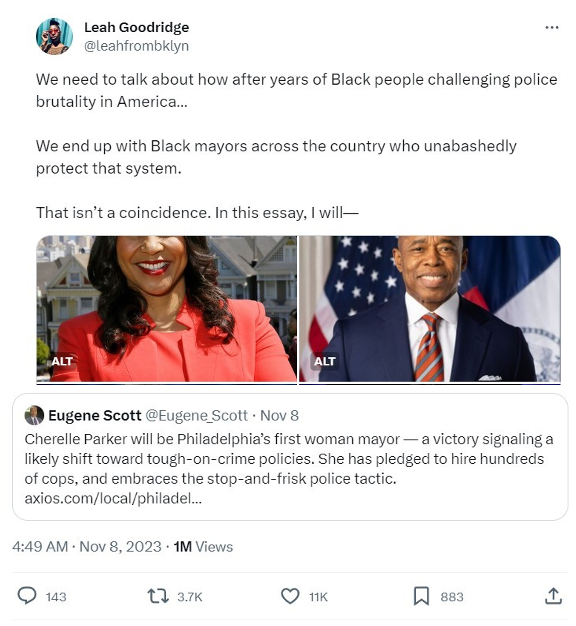
Take, for example, this post here. The post challenges the people in power, the people who have the authority to change the way police interact with the public. This is a completely valid argument from an average person on ‘X’.
This post, as of November 8th when it was published, has received one million views. It has received thousands of likes and reshares, and just under a thousand saves. It was one of the top posts on the day I searched.
The post is not explicitly anti-police, but it is very clearly biased against policing and Law Enforcement as they are today. It portrays Law Enforcement in a clearly negative light.
It is posts like these that affected my father’s ability to feel safe at work, even as a detective not always in the line of fire.
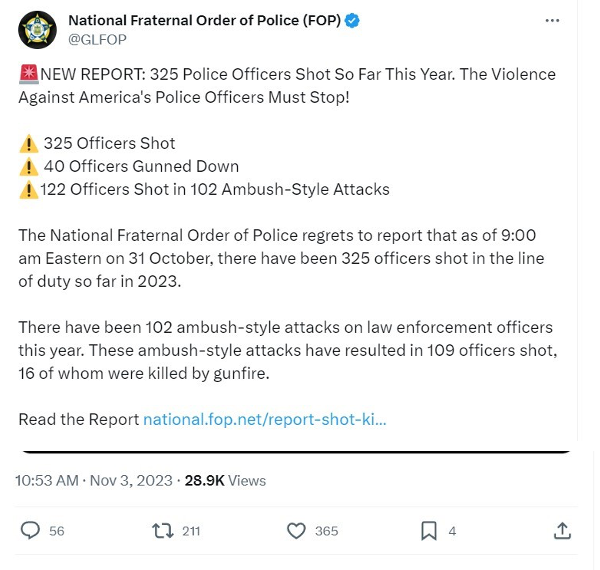 Now take this example. A certified account on ‘X’ posting statistics on police officers who were shot in the line of duty this past year.
It has less than thirty thousand views, and not even five-hundred reshares or likes.
And it was posted only a few days prior to the first ‘X’ example.
This post is not only supportive of Law Enforcement, but is also educational. It is sharing statistics from across the nation and sharing them in an unbiased way.
So why is it receiving less likes, views, and shares than the critique?
Because social media promotes the negative, and it is far easier for posts that are critical of something to gain traction. Positive posts are more frequently online, as shown by the previous Protection1 graph, but the popularity is far lower. This means it is much more difficult to promote certain views online—any views, not just those relating to policing (that is simply an example I relate to).
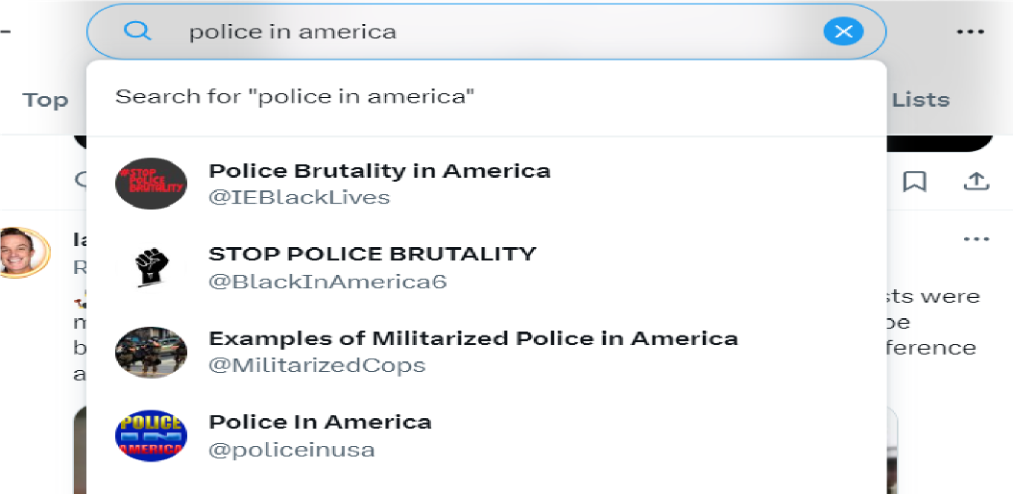
I would have included examples from both Instagram and Facebook on here as well, but the algorithms of these two sites made it impossible to search the topic at hand without getting curated responses—another huge issue. Algorithms contribute to the flow of information just as much as others do, as they can be used to cater to certain belief systems rather than the spread of all information equally.
This unproportionate distribution of fair coverage online creates toxic media environments built on omitting information that is considered “not useful” to whoever is making the post. But omitting facts creates misinformation, and a misinformed audience can lead to rash decisions. Words have power, and it is our responsibility as readers and writers to educate others and check others to ensure that what is being spread is not only opinion, but facts to support as well.
As a reader, it is my responsibility to question what I am being told, to form my own opinions.
As a writer, it is my responsibility to present my opinion honestly and openly.
As a reader of this argument, it is your responsibility to take my words to heart, to question, question, and always question what you see online. It could make all the difference to someone you might never even meet.
It might make all the difference to the heart of a young woman who has witnessed her father lose love for his career because he has lost people who care about him as much as he cares about protecting the world around him.