
"Ignorance, Racism, and Denial: The Legacy of Police Violence on College Campuses" by Heaven Alvarado
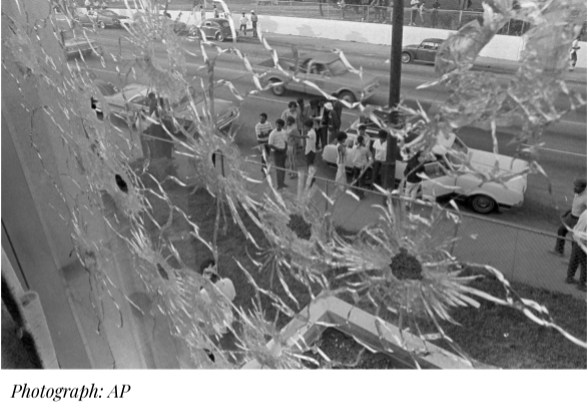
It is not unusual that my friend, an American history major, had never heard of the Orangeburg Massacre. A testament to its obscurity, out of the fifty people I have quizzed on the shooting, not a single person recognized it.
This is remarkable in the fact that, despite popular perception, the Orangeburg Massacre was the first time college students were slain by a governmental agency on a college campus. Regardless of its place in history, the lives lost in Orangeburg and at Jackson State–where a similar shooting took place–were overshadowed by the lives lost in the Kent State Massacre, a disparity indicative of the deeply-rooted racism embedded into American culture.
Group Fires On Police At Orangeburg
February 9th, 1968, South Carolina’s newspaper printed the day’s scoop–a shootout between
National Guardsmen and black South Carolina State students. Contrary to press and governmental misinformation, the black student victims who were fired upon that day had neither weapons nor motives of fatal violence.
In the months leading up to the shooting, black South Carolina and Claflin University students protested the local bowling alley, All-Star Bowling Triangle’s segregationist policies. Four years had passed since the Civil Rights Act of 1964, prohibiting racial discrimination. Yet the bowling alley’s owner, Harry Floyd’s claims of “private property” allowed him to refuse entry to black patrons.
As per routine, the night of Monday, February 5th, the students gathered, protested peacefully, and left when Harry Floyd refused them entry. The next day, the crowd returned, but miscommunications and escalating tensions led to police violence. Windows were broken, and the unarmed students were blasted with water from fire hoses and beaten with billy clubs. Eight students were sent to the hospital.
In the next two days, student’s requests to hold a march and demands that local establishments, including the local hospital, be desegregated were denied by the city. The press refused to publish the student leaders’ demands. Tensions escalated. Frustrated students gathered on U.S. Route 601 and threw rocks at cars containing white passengers. Three Claflin College students were shot outside the campus. Wednesday night, two white men drove through campus and fired at the students. That night, Governor McNair radioed in the National Guard, summoning more than three hundred fifty Guardsmen to the city.
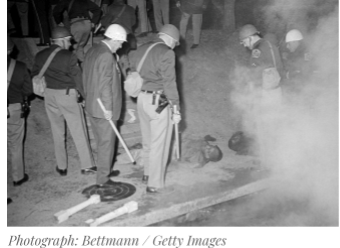
Thursday night, students gathered on South Carolina State’s campus, building a small bonfire at its entrance. They taunted and threw rocks at the Guardsmen attempting to disband them. The fire was extinguished and a police officer was struck by a wooden banister. The Guardsmen and local police, claiming to hear gunshots, opened fire, killing three and injuring twenty-eight. None of the students were armed.
Students from Claflin, SC State, and
Wilkinson High School were among the injured. Freshman Samuel Hammond, high school student Delano Middleton, and eighteen-year-old Henry Smith were killed in the slaughter.
In the aftermath, local civil rights activist Cleveland Sellers, present at the protests, was arrested for inciting a riot. Not a single police or Guardsman was arrested. Reportedly, the policemen celebrated afterward, heard on the radio bragging, “You should have been here, ol' buddy; got a couple of 'em tonight.”
Local press claimed the students shot first and the public sided with the police officer’s brutality. Despite this being the first time police shot and killed students on a U.S. college campus, not a single major publication covered the story.
Racial Tensions Reach Boiling Point in Mississippi
Just ten days after National Guardsmen shot and killed four at Kent State University, highway patrolmen shot and killed two black Jackson State students on the college’s campus. Despite the proximity of the two events, very little of the tensions present that Thursday night can be attributed to the events at Kent State.
For multiple months before May 14th, the Jackson State students had been repeatedly harassed by white motorists passing through campus, shouting racial slurs and sexual epithets at the female students. In protest, Thursday, May 14th, around a hundred black students students gathered, pelting rocks at passing white drivers. That night, rumors circulated that local activist Charles Evers had been killed, escalating tensions. In response, a non-university student set fire to a truck, drawing both firefighters and local policemen and highway patrolmen in full riot gear. They were accompanied by a fully armored personnel carrier, purchased by segregationist mayor Allen Thompsan, purportedly in response to the events of Freedom Summer.
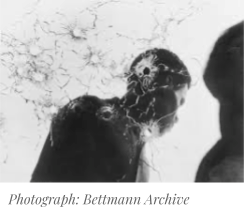 The law enforcement attempted to disperse the crowd, and in the confusion, a bottle was broken on the ground. The policemen, claiming sniper fire, opened live rounds on the crowd and at the women’s dormitory closest to the gathering. Around twelve were injured, and in the fire, Philip Lafayette Gibbs and James Earl Green were fatally wounded, both by shotgun rounds. No such sniper was found.
Though a federal commission was assembled to investigate the incident, no one was charged with Gibbs or Green’s death. Small protests and memorials were held in the days after.
“Bums” Killed At Kent
Even more than fifty years after tragedy was committed on Kent State’s campus, the days leading up to the shootings and the chaos left in its wake are burned into America’s cultural memory. The photograph of Mary Ann Vecchio’s anguished figure, kneeling over a slain student is one of the most easily recognizable images from the decade. In the days after, millions of students striked, closing down over four hundred universities. The defiant slogan “They Can’t Kill Us All.” characterizes the sentiment of a decade. Nixon’s labeling of the student protesters as “bums,” and his press secretary’s denouncement of the protests enraged thousands. Crosby, Nash, Stills, and Young’s “Ohio” condemning Nixon’s administration was and remains widely popular.
Given its place in popular culture, most are familiar with the Kent State tragedy. Even still, I think it's prudent to provide some background.
On Thursday, April 30th, 1970 President Richard Nixon announced the U.S. invasion of Cambodia. The next day, students at hundreds of colleges across the U.S. gathered to protest the invasion, including those at Kent State. That night in Ohio protests grew violent and the local policemen responded to disperse the crowd. That same evening, Mayor Leroy Satrom declared a state emergency.
The following Saturday, May 2nd, Mayor Satrom requested assistance from the National Guard, who arrived later that night to find the campus ROTC building being burned down in protest. Tear gas was used to disband the protesters.
The next morning, Sunday, May 3rd, the Ohio Governor threatened to declare a state of emergency. In a critical moment of miscommunication, The Guard and university officials assumed martial law reigns. Rallies were banned, and confrontations between the Guard and Students continued throughout the night.
On May 4th, Monday, 1970, a second protest rally was organized despite the university’s ban.
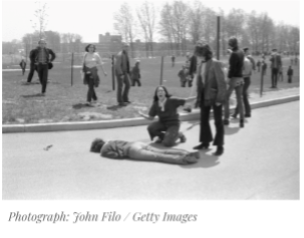 On May 4th, Monday, 1970, a second protest rally was organized despite the university’s ban. Over three thousand people gathered in attendance. The National Guard arrived carrying live rounds, and their attempts to disperse the crowd proved unsuccessful. Tear gas canisters were again launched at the crowd while the Guard retreated to a nearby hilltop. The Guard, claiming self-defense, fired on the unarmed protesters. Four: Allison Krause, Jerrey Miller, Sandra Scheuer, and William Schroeder succumbed to their wounds. Nine others were injured.
In August 1973, eight former guardsmen were charged with violating student civil rights.
The Legacy Left Behind
Given it was neither the first nor the last murder of students on a college campus by policemen, why did Kent State have such a larger impact on the public consciousness than either Orangeburg or Jackson State?
There are many theories on the matter.
Some historians have proposed that John F. Kennedy and Martin Luther King’s assassinations in 1963 and 1968 respectively preceding the Orangeburg incident largely overshadowed the killings in importance. While some small creedence can be leant to this theory in the immediate aftermath, as the years passed and the public remained largely unaware of the shootings at all, it begins to wear down. As historians bound and still bind our updated history textbooks, surely any light research would reveal the Orangeburg Massacre as the first of its kind–not Kent State. Yet, the tragedy remains largely undiscussed.
Another theory claims that the anti-Vietnam War sentiments that drove the gathering that day on Kent State’s campus were more of a hot topic issue at the time of the shootings than civil rights. While this too can account for some of the disparity, the claim falls apart when you examine the legacy of the 60s and early 70s.
Civil rights were just as incendiary and divisive an issue at the time.
Just four years before the Orangeburg massacre, three young activists–James Chaney, Andrew Goodman, and Michael Schwerner–were murdered as a part of the Freedom Summer campaign, where they had been working to help black citizens register to vote. Their murder falls firmly under the category of a civil rights issue, and yet their initial kidnapping/disappearance captured national attention. Still, today, even after the mystery of their disappearance was solved, young students are taught of the murders as an example of escalating racial tensions in Mississippi. The key to national attention?
Schwerner and Goodman were white.
Despite popular denial, Orangeburg and Jackson State never received their fair share because the victims were black. Both atrocities in their own accord, neither of the college’s victims received apologies until the 2000s. Jackson State received theirs as late as 2021. The Kent State victims received theirs in May of 1990.
Even still, in 2024, very few are aware of the dead in Orangeburg, South Carolina, and Jackson, Mississippi. This becomes even more concerning an injustice as political tensions escalate once more. Genocide looms in Palestine and student protests are once more marked as incendiary. Escalating numbers of innocent black people are killed by racist police o cers, and the government looms as a belligerent, and increasingly militant disciplinary force intent on discouraging rebellion. We must acknowledge and rectify the failures of our past now if we are to avoid their imminent and violent repetition.